
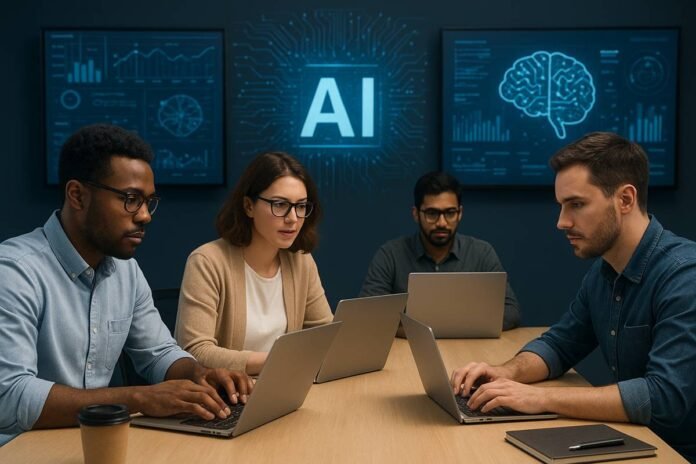

Innovation is a factor defined to succeed in the modern digital economy. Organizations are under constant pressure to distribute new products, services and solutions quickly to the market by quickly bringing price and surge competitors. One of the most powerful strategies is to use today, the formation of integrated cross-functional teams of AI developers.
These teams bring different skills, knowledge and approach together, and when combined with artificial intelligence, they run fast decision -making, smart insights and more effective processes. Many companies also choose to hire an AI development company to take advantage of cost-effective expertise and a deep talent pool.
The Evolution of Cross-Functional Teams
Cross-functional team was originally designed to break the silos and allow professionals from different departments to work together to a common goal. Engineers, Sephers, designers and analysts who work isolated often reduced progress and caused misunderstandings and delays. By integrating several skills kits into the same team, organizations gained efficiency and improved adjustment.
However, with the use of artificial intelligence, cross -functional collaboration has been expanded to new heights. AI developers bring special abilities such as automation, machine learning and data analysis, which allows the teams to solve complex problems much faster than traditional perspectives.
How AI Developers Enhance Collaboration
The role of AI developers in cross-functional teams has become increasingly important. They enable access to integrated data sets that remove silos and provide a version of truth to all members. By creating a model that analyzes and interpreting large amounts of information, the quick prototypes, more efficient testing and more individual solutions for customers support.
AI also improves future abilities, so that teams can estimate customer behavior, market change and possible risks. These contributions ensure that cross -functional collaboration is not only creative and supple, but also based in data -driven insights that accelerate innovation.
Tangible Benefits of AI-Powered Teams
AI’s strong cross -functional team achieves many remarkable results that directly affect organizational results. The market has improved significantly because the products are less delayed by the execution. When AI-insight products provide new directions for design or marketing strategies, creativity increases. The decisions are more accurate and timely thanks to real -time analysis, while automation reduces operating costs.
The scalability is also increased when A-controlled procedures can be increased in new projects and initiatives without the need for complete redesign. In parallel, partnership helps an ecommerce SEO company companies coordinate these AI-operated innovations with strong online visibility, ensuring that growth and innovation are corresponded to increased digital access.
The Human-AI Partnership
Despite the power of artificial intelligence, it is necessary to remember that AI does not replace human simplicity, but increases it. The actual strength of cross-functional teams lies in partnership between human expertise and AI skills. While AI developers create systems to manage duplication or data-intelligent features, people focus on strategy, sympathy and creativity.
In the health care system, for example, can treat the journals of thousands of patients to suggest possible diagnosis, while doctors use their knowledge to plan personal treatment. This balance ensures that innovation remains both effective and human -centric.
Real-World Applications Across Industries
Integration of AI developers into cross-functional teams is already forming industries again. In the health care system, such teams create clinical equipment, predict the pattern of disease and increase patient treatment by combining medical expertise with AI-driven insights. In e-commerce, AI developers work with logistics, marketing and designers to create personal purchasing experiences and streamlining supply chains.
Financial institutions rely on AI-controlled teams to detect fraud, improve customer service and design investment platforms. Production companies use future maintenance and automatic quality control by combining engineering expertise with AI solutions. These examples highlight the versatility and value of AI-enabled cross-functional innovation.
Addressing the Challenges
Despite the opportunities, the integration of AI developers in cross-functional teams offers challenges. Cultural resistance often occurs when employees are afraid of job offset or feel uncertain about the AI role. Integrating AI with cultural monuments can also be technically complicated. In addition, organizations can meet skills intervals when employees lack sufficient competence to cooperate effectively with AI units.
Ethical thoughts, such as securing justice and to avoid prejudice in AI-driven decisions, are equally important. To remove these challenges, leaders should focus on training, openness and clear communication. The creation of the confidence and adjustment of the AI initiative with organizational values is essential for long -term success.
Creating a Culture of AI-First Collaboration
Organizations that want to unlock the entire potential of cross -functional teams with AI should cultivate a culture that embrace collaboration and continuous learning. Encouraging employees to encourage and gain a basic understanding of AI concepts promotes the Smoothie cooperation. Promoting open communication gives significance to different approaches and integrated.
Agile function is especially effective as they emphasize adaptability, relapse and reaction – quality that matches well with AI development. It is important that businesses should prefer that moral guidelines are AI application transparent and fair. Participating with an experienced AI development company helps organizations access advanced equipment, best practices and technical expertise that supports successful AI.
Looking Toward the Future
The future of innovation will be defined by cross-functional teams that initially integrate AI developers into the workflow. Since the AI technology continues to move, these teams will be furnished quickly to solve complex problems and create groundbreaking solutions. Generative AI, learning reinforcement and autonomous system will further improve this process.
Today, companies that adopt AI-driven cooperation will place themselves as leaders in shaping industries. By combining human creativity with AI’s computational power, companies will achieve successes such as re-defined customer experiences, streamlining operations and expanding the development opportunities.
Conclusion
Innovation is no longer optional – it is the basis for existence and development in a competitive global market. The integrated cross-functional teams with AI developers represent a perfect way to sharp, smart and more scalable innovation. By eliminating silos, enabling data -driven insights and promoting rapid use, these teams create a powerful coordination between human talent and artificial intelligence.
Business terminals This model will not only speed up the market, but will also unlock creativity and flexibility. The future is one of those who invest in collaboration, AI embraces in a responsible way and gives their teams the opportunity to convert challenges to opportunities.